
What the Leadership Programme is about
THE LEADERSHIP PROGRAMME
ANYTHING IS POSSIBLE

What the Leadership Programme is about
Education Character Confidence
Aim – The Leadership Programme aims to provide assistance to developing an educated citizen of outstanding character by developing each young person in not only their knowledge (education) but also in the key areas of their confidence and character.
Vision – Developing educated citizens of outstanding character.
Mission – The Leadership Programme will provide all young people with progressive leadership training that will develop their character and provide them through experiential learning with the confidence to assume leadership roles in the school, or be an effective follower. It will provide young people with a firm basis from which to grow into an effective leader or follower in their post secondary education and career to meet the challenges in their life beyond school.
Success will look like this – A young person leaving the school who is confident, positive, and proactive who is known for their good character. Those who encounter them will see them stand out as having the potential to be a future leader or hard working contributor in whatever path they decide to follow.
Principles – The foundations on which the Leadership Programme will continue to be developed is consistent with the following as defined in the 2007 Curriculum:
• High expectations
• Treaty of Waitangi
• Cultural diversity
• Inclusion
• Learning to learn
• Community engagement
• Coherence
• Future focus
Values – The NZ curriculum places emphasis on the need for students to be encouraged to value:
• Excellence, by aiming high and by persevering in the face of difficulties
• Innovation, inquiry, and curiosity, by thinking critically, creatively, and reflectively
• Diversity, as found in our different cultures, languages, and heritages
• Equity, through fairness and social justice
• Community and participation for the common good
• Ecological sustainability, which includes care for the environment
• Integrity, which involves being honest, responsible, and accountable and acting ethically and to respect themselves, others,
and human rights.
Framework
Education
Confidence
Character
Domain 1 – Education. Curriculum driven based on providing each young person with the highest level of education they can attain: Social Sciences, Technology, Science, Mathematics and Statistics, Learning Languages, English, Health and Physical Education, and Arts. Core subject teachers all play a vital role in communicating the core values of the school and will also be expected to facilitate Learning Leadership Books 1-4.
Domain 2 – Character. The aim of this domain is to develop the “outstanding character” piece of the educated young person. Core values form the backbone of this aspect and the ethos and values of the school will shape the youth who pass through the school. Positive role modelling is an essential component to the character development of each young person.
Domain 3 – Confidence. Finally, the aim of this domain will be to develop a young person's confidence to stand tall whilst they are in, and after leaving school. Self-confidence, self-control and self-awareness will be fostered using a range of methods to develop the communication skills of each young person through curriculum subjects as well as through such mediums as mentoring, goal setting and formal training in physical social teaching to develop self confidence in each young person. The school will deliver many opportunities on the journey through school to gain confidence to begin life after school.
The Scholastic Leadership Model – The Scholastic Leadership Model developed by the school recognises that to develop an educated person of outstanding character requires a unique balance to be achieved between the input from the student, their parents/home life and their teachers/the school. If one part is not pulling its weight, the triangle becomes isosceles. It recognises the importance of the input of the school philosophy to build the IQ as well as the EQ of each young person. Their education is balanced with the experiences gained through the school to develop his EQ (Character and Confidence). By living the school values of Courage, Pride, Respect, Industry, Humility and Integrity, each young person is capable of achieving the school vision to complete their schooling as
“an educated citizen of outstanding character.”
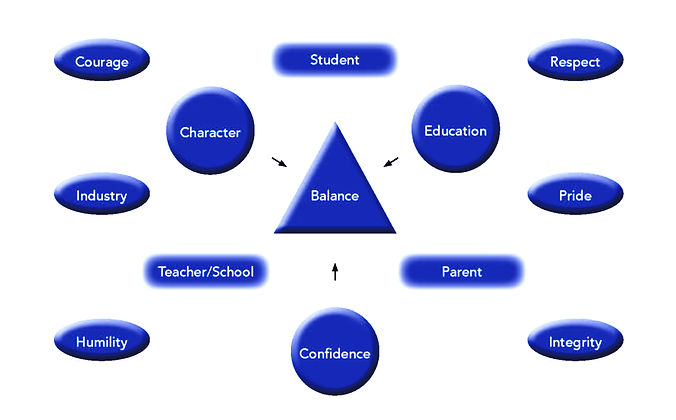
Responsibility – Our senior students are leading the school and their peers well. The school award of 'National School of Character' by the New Zealand Foundation for Character Education provides evidence that the work of the Leadership Programme and character education in the school per se are developing educated men of outstanding character for our society. Our collective challenge continues to be to build on this firm foundation and to take it to the next level. Role modelling, goal setting and encouraging our students at all levels to reach the next level of excellence is required. It is our belief that high levels of expectation, consistency and positive reinforcement of our values and vision provide the key to success.
New Zealand Curriculum Five Key Competencies – The NZ curriculum identifies five key competencies considered to be vital capabilities for living and lifelong learning. The Leadership Programme at PNBHS is specifically tailored to deliver results with our young men in each of these, but provides a real point of difference in delivering results in the areas of managing self, relating to others and participating and contributing.
The Five Key Competencies are as Follows:
Thinking – Thinking is about using creative, critical, and metacognitive processes to make sense of information, experiences, and ideas. These processes can be applied to purposes such as developing understanding, making decisions, shaping actions, or constructing knowledge. Intellectual curiosity is at the heart of this competency.
Students who are competent thinkers and problem-solvers actively seek, use, and create knowledge. They reflect on their own learning, draw on personal knowledge and intuitions, ask questions, and challenge the basis of assumptions and perceptions.
Using Language, Symbols, and Texts – Using language, symbols, and texts is about working with and making meaning of the codes in which knowledge is expressed. Languages and symbols are systems for representing and communicating information, experiences, and ideas. People use languages and symbols to produce texts of all kinds: written, oral/aural, and visual; informative and imaginative; informal and formal; mathematical, scientific, and technological.
Students who are competent users of language, symbols, and texts can interpret and use words, number, images, movement, metaphor, and technologies in a range of contexts. They recognise how choices of language, symbol, or text affect people’s understanding and the ways in which they respond to communications. They confidently use ICT (including, where appropriate, assistive technologies) to access and provide information and to communicate with others.
Managing Self – This competency is associated with self-motivation, a “can-do” attitude, and with students seeing themselves as capable learners. It is integral to self-assessment. Students who manage themselves are enterprising, resourceful, reliable, and resilient. They establish personal goals, make plans, manage projects, and set high standards. They have strategies for meeting challenges. They know when to lead, when to follow, and when and how to act independently. Student goal setting and follow up has been identified as a key focus area.
Relating to Others – Relating to others is about interacting effectively with a diverse range of people in a variety of contexts. This competency includes the ability to listen actively, recognise different points of view, negotiate, and share ideas. Students who relate well to others are open to new learning and are able to take different roles in different situations. They are aware of how their words and actions affect others. They know when it is appropriate to compete and when it is appropriate to co-operate. By working effectively together, they can come up with new approaches, ideas, and ways of thinking.
Participating and Contributing – This competency is about being actively involved in communities. Communities include family, whānau, and school and those based, for example, on a common interest or culture. They may be drawn together for purposes such as learning, work, celebration, or recreation. They may be local, national, or global. This competency includes a capacity to contribute appropriately as a group member, to make connections with others, and to create opportunities for others in the group. Students who participate and contribute in communities have a sense of belonging and the confidence to participate within new contexts. They understand the importance of balancing rights, roles, and responsibilities and of contributing to the quality and sustainability of social, cultural, physical, and economic environments.